Dog Training in Colorado Springs: Classes, Costs and How to Choose a Trainer
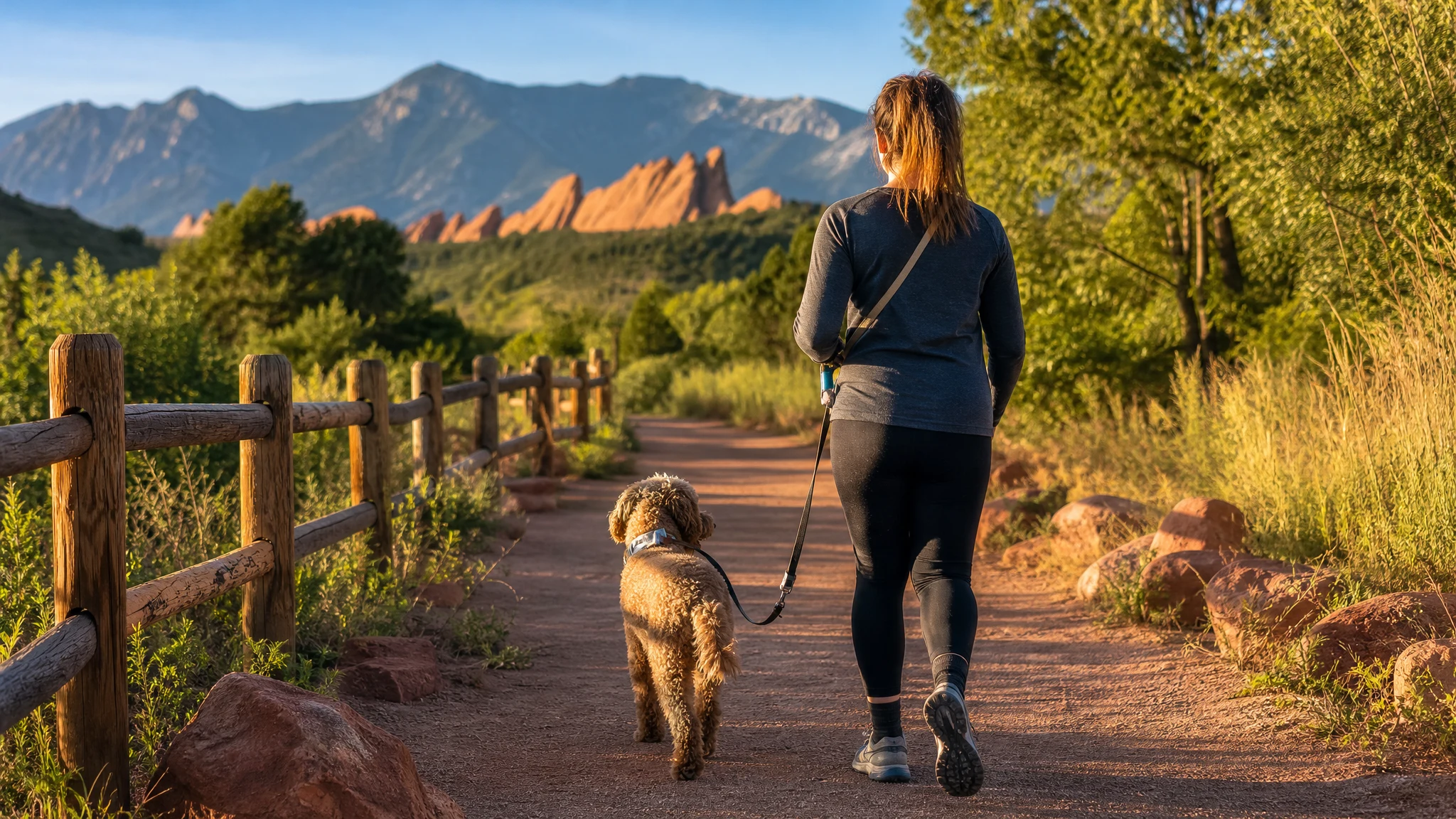
General training information. For aggression, sudden behavior changes or health concerns, see your veterinarian first.
Training a dog in Colorado Springs comes with local details. There are city leash and license rules to follow. There are fenced parks with their own entry rules, and trails where a loose dog can cause real trouble. This guide covers the main kinds of dog training, what humane reward-based training looks like, how to find a qualified trainer, what some local services cost, and how the rules and places around the city shape your plan.
Key takeaways
- Dog training in Colorado Springs comes in four common formats: group classes, private sessions, day training and board-and-train. Each suits a different dog and a different household.
- The American Veterinary Society of Animal Behavior (AVSAB) recommends reward-based training and advises against aversive methods. Look for trainers who work that way.
- The CCPDT directory lists certified trainers in Colorado Springs. A certification shows a trainer has passed an assessment. It does not tell you whether the trainer is right for your dog.
- House of Dog Training publishes prices that range from $218.75 for a group class to $200 for an initial in-home session. Ask any trainer for current prices in writing.
- Dogs must be leashed except in designated off-leash areas, and dogs over 4 months old need a city license, according to the Humane Society of the Pikes Peak Region (HSPPR).
- Aggression toward people is not a do-it-yourself problem. See a veterinarian and a certified behavior professional.
Contents
- The kinds of dog training available
- What reward-based training is and why it matters
- Certified trainers and how to choose one
- Published prices and what to budget
- Colorado Springs rules that shape training
- Parks and places to practice
- Weather and wildlife to train around
- Putting a plan together
The kinds of dog training available
Most dog obedience training in Colorado Springs falls into one of four formats. The right one depends on your dog's age, your goals and how much time you can give.
Group classes
A group class is a weekly session where several dogs and their owners learn together. You learn the skills, and you practice them around other dogs and people. That is a real advantage, because a dog who sits perfectly in the living room often forgets everything at the park.
Group classes suit puppies, new owners and dogs who need practice focusing in a busy setting. They are usually the least expensive format. They are less suited to a dog who is very fearful or reactive around other dogs, since a crowded room may be too much. If that sounds like your dog, ask a trainer about a private session first.
House of Dog Training, a Colorado Springs business, publishes two puppy group class listings. Puppy K runs one hour weekly for 8 weeks and is for puppies 8 weeks to 5 months old. Puppy K2 runs one hour weekly for 7 weeks and is for dogs 6 months to 1 year old. Prices appear in the costs section below.
Private sessions
A private session is one-on-one time with a trainer, either at a training facility or in your home. The trainer can focus on your dog and your household. This format works well for specific problems such as pulling on the leash, door manners, fear of strangers or a dog who struggles in a group.
In-home sessions show the trainer exactly where the trouble happens. That helps with doorbell barking, counter surfing and greeting guests. House of Dog Training lists both facility and in-home private sessions, with prices below.
Day training
In day training, the dog spends part of the day with a trainer, who works on skills while you are away. Then you learn how to keep up the work at home. It can help busy households, but it only works if the owner is taught the same cues and follows through. A dog trained by someone else will not automatically listen to you.
I do not have a published local price for day training. If you are interested, ask each trainer what the day includes, how many dogs they work with at once, and what you will be taught at pickup.
Board-and-train
Board-and-train means your dog stays with the trainer for a set period and gets daily training along with lodging. Some owners like the head start. Others find the handoff stressful for the dog, or worry about not knowing what happens during the stay.
If you consider this option, ask the questions below.
- What methods will be used? Ask for a plain description, and expect reward-based answers.
- Can you see where your dog will stay and sleep?
- How much time will you spend with the trainer learning to handle your dog afterward?
- What happens if your dog is not comfortable?
House of Dog Training publishes a boarding-with-training price, listed below.
What reward-based training is and why it matters
Reward-based training means you teach the dog what to do and pay for it. When your dog sits, you give a treat, a toy, a game or praise. Behaviors that earn something good happen more often. Unwanted behaviors are managed, redirected or simply not rewarded, and you teach a better alternative.
The American Veterinary Society of Animal Behavior (AVSAB) recommends reward-based training. AVSAB also advises against aversive methods, which are the ones that rely on pain, fear or intimidation. The concern is that these methods can raise a dog's stress and fear, and can make some behavior problems worse.
What it looks like in practice
- Rewards that matter to your dog. Small, soft treats work for many dogs. Others will work for a tug toy or a ball.
- Short sessions. Five minutes, a few times a day, beats one long frustrating session.
- Clear cues. Everyone in the house uses the same word for the same behavior.
- Gradual challenge. You build from the kitchen to the front yard to a quiet street, and only then to a busy park.
- Management. Baby gates, leashes and closed doors prevent rehearsal of bad habits while the dog learns.
Methods to avoid
Do not use shock collars, prong collars or choke collars. Do not use alpha rolls, scruffing or any dominance-based method. Dogs are not trying to take over your home. They are learning from what works for them. A trainer who promises quick fixes through force is not following the approach AVSAB recommends.
This matters locally too. The City of Colorado Springs rules for fenced dog parks require that pinch (prong) and spike collars be removed before entering. That rule fits well with the humane approach described here.
Questions to ask about methods
- What do you do when a dog gets something wrong?
- What tools do you use? A flat collar or a harness with a leash is a reasonable answer.
- Can I watch a class before enrolling?
- How do you handle a nervous dog?
Be cautious if the trainer is vague, dismissive of your questions or promises certain results. Behavior change depends on the dog, the owner and the situation, and no honest trainer can promise an outcome.
Certified trainers and how to choose one
Dog training is not a regulated profession, so anyone can use the title. Certification is one way to check that a trainer has met a standard. The Certification Council for Professional Dog Trainers (CCPDT) keeps a public directory of certified trainers.
Colorado Springs trainers with listed credentials
The following trainers appear in public listings with Colorado Springs as their area. The details below come only from those listings. This is not a ranking and not a recommendation. Contact any trainer yourself and ask about methods, experience and fit.
- Carol Rebecca Abrams is listed in the CCPDT certified dog trainer directory with CPDT-KA (Certified Professional Dog Trainer, Knowledge Assessed) and CBCC-KA (Certified Behavior Consultant Canine, Knowledge Assessed). Her profile links to a website for Best Friends Dogs.
- Miguel A. Gonzalez is listed in the CCPDT directory with CPDT-KA, with the Humane Society of the Pikes Peak Region shown as the employer.
- Pamela Meyerhofer is listed on the trainers page of House of Dog Training with PDT, PDT-Geek and CPDT-KA.
- Astrid Tryon is listed on the House of Dog Training trainers page as the owner, with CPDT-KSA.
For behavior concerns, House of Dog Training's trainers page also lists Angie Neal with the credential CDBC. The page does not say which organization issued that credential, so ask her or the business directly if that matters to you.
This is not a complete list of everyone who trains dogs in the city. Other qualified trainers may work in Colorado Springs. The CCPDT directory is a good place to look for more.
What the credentials mean
CPDT-KA stands for Certified Professional Dog Trainer, Knowledge Assessed. The words "Knowledge Assessed" mean the trainer passed an exam. It does not mean someone watched them train. A certificate is a starting point, not proof that a trainer is a good match for your dog.
A simple checklist for choosing
- Ask about methods first. You want reward-based answers with no force or intimidation.
- Ask about experience with your situation. A puppy, a shy adult and a dog who barks at everyone need different plans.
- Observe a class if allowed. Watch whether dogs and owners look relaxed and whether the trainer is patient.
- Ask for the full price. Find out what is included, how many sessions, and what happens if you miss one.
- Check vaccine requirements. I do not have a published local standard for puppy class vaccines, so ask the trainer what they require and ask your veterinarian when your puppy can safely join.
- Trust your own read. If a trainer rushes you, talks down to you or is rough with your dog, leave.
When you need a veterinarian and a behavior professional
Sudden behavior changes can have medical causes such as pain or illness. If your dog changes suddenly, see a veterinarian first. If your dog growls, snaps or bites people, do not try to fix it with general obedience classes. Call your veterinarian and work with a certified behavior professional. Keep everyone safe in the meantime by using distance, gates and leashes.
Published prices and what to budget
Prices vary by trainer, format and length. The only published local prices I can point to come from House of Dog Training's price page. They are useful as one example of what a Colorado Springs training business charges, but they may change, so confirm with the business before you plan around them.
| Service at House of Dog Training | Published price |
|---|---|
| Puppy K group class (8 weeks to 5 months, one hour weekly for 8 weeks) | $250 |
| Puppy K2 group class (6 months to 1 year, one hour weekly for 7 weeks) | $218.75 |
| Private session at the facility, 60 minutes | $150 |
| Private session in home, initial 90 minutes including assessment | $200 |
| Boarding with training, per night (includes 30 minutes of training) | $110 |
The price page adds a few details. A facility private session costs an extra $40 if an assistant trainer is required, and a $50 assessment is required. Standard boarding without training is listed at $65 per night.
How to compare
Divide a class price by the number of sessions to see the cost per hour. Puppy K at $250 for 8 weekly hours works out to a lower hourly rate than a single private session. But a lower price is not automatically better. A private session may solve a problem that a group class cannot.
When you compare any two trainers, ask the following.
- What exactly is included, and for how many weeks?
- Are there extra fees, such as assessments or assistant trainers?
- What is the cancellation or makeup policy?
- Do you need to buy equipment, and what kind?
I do not have published prices for other Colorado Springs trainers, so check each business directly.
Low-cost ways to start
You do not need to spend a lot to begin. You can start with a few minutes of daily practice at home, using part of your dog's regular meals as rewards. Many dogs learn sit, down, come when called and walking calmly on a leash with plain practice and patience. A class or session can then fill in the gaps.
Colorado Springs rules that shape training
Training goals are easier to set once you know the rules your dog must live under. The following comes from the Humane Society of the Pikes Peak Region (HSPPR), which runs Animal Law Enforcement for the area, along with the sources noted. Rules can change, so check with HSPPR or the city for current details.
Leash law
HSPPR says dogs must be on a leash at all times except in designated off-leash dog parks. The page I relied on does not state a maximum leash length, so check with HSPPR or the city if that matters to you. HSPPR's materials point to the city code section on restraining animals, but you should confirm the exact section with the agency.
This is why a reliable recall is valuable but not a replacement for a leash. Even a dog who comes when called must stay leashed outside designated areas.
Licensing
HSPPR says a license is required for every dog and cat over 4 months old in the City of Colorado Springs, and HSPPR issues it. According to HSPPR's License Your Pet page, fees are as follows.
- Spayed or neutered dogs: $20 for 1 year or $40 for 3 years.
- Intact dogs: $35 for 1 year or $75 for 3 years.
- Seniors 65 and older, spayed or neutered: $10 or $25.
- Seniors 65 and older, intact: $20 or $55.
- A $20 late fee applies 30 days after expiration.
You will also need a rabies certificate to license a dog.
Rabies vaccination
HSPPR states that rabies vaccination is required for all dogs and cats and says this is Colorado law. Ask your veterinarian to keep your dog's records current. You will need the certificate for licensing, and fenced city dog parks require dogs to be properly inoculated and licensed.
Barking
HSPPR says unprovoked, persistent barking at any time of day or night that disturbs the peace and quiet is unlawful. If barking is an issue in your home, treat it as a training and management project. Figure out what triggers it, such as people passing the window or being left alone, and teach an alternative behavior. Barking that comes with panic when you leave may be separation distress, which is worth raising with your veterinarian and a certified professional.
Number of dogs
HSPPR's Laws and Ordinances page says households may have up to 4 adult dogs and 4 adult cats under City of Colorado Springs code 6.7.106(F). An adult is any dog or cat over 4 months old. If you have a multi-dog home, plan training time for each dog separately as well as together.
Dangerous dogs
I could not confirm the city's own dangerous dog process, so contact HSPPR Animal Law Enforcement, which takes reports of dangerous or aggressive animals. Colorado statute C.R.S. 18-9-204.5 defines a dangerous dog as one that inflicts bodily or serious bodily injury on, or causes the death of, a person or domestic animal. It also covers a dog showing tendencies a reasonable person would believe could cause such harm, and a dog that fights or is trained to fight. The statute says an owner whose dog inflicts bodily injury on a person commits a class 2 misdemeanor.
The practical message is simple. If your dog shows aggression toward people, act early. See a veterinarian and a certified behavior professional, and manage the dog's environment so no one gets hurt.
Parks and places to practice
The City of Colorado Springs parks department lists several designated dog areas. They give you places to practice real-world skills and let your dog play where it is legal. City Code requires dogs on a leash in city parks and on city trails except in designated areas.
Fenced dog parks
- Antlers Dog Park (Downtown Dog Park) at Antlers Park downtown has two separate fenced play areas, one for small dogs and one for larger dogs. It has synthetic turf and is ADA accessible.
- Palmer Park fenced dog park is on the old baseball field, 0.3 miles from the Maizeland entrance.
- Cheyenne Meadows Park dog park is in the south portion of the park, in a native grass area off Charmwood Dr. and Canoe Creek Dr.
- Rampart Park dog park is just east of the baseball diamond.
The city lists the following rules for the fenced enclosures at Palmer Park, Cheyenne Meadows and Rampart Park.
- Dogs must be accompanied by a person at least 16 years old.
- Dogs stay on leash until inside the enclosure.
- No more than three dogs per person.
- Dogs with an aggressive history must wear a muzzle.
- Dogs must be properly inoculated, licensed and not in breeding condition.
- Pinch (prong) and spike collars must be removed before entering.
The city page for Antlers Dog Park does not list hours or rules, so check with the city before you go. The city page does not publish hours for the other parks either.
Unfenced dog runs
- Garden of the Gods Park dog run is east of Rock Ledge Ranch and south of Gateway Rd. It is unfenced.
- Red Rock Canyon Open Space dog loop covers designated Dog Loop trail areas south of the main parking lot. It is unfenced.
- Palmer Park dog run (Yucca Flats) is unfenced.
The Garden of the Gods listing links to a dog map and policies PDF on the city page, so read that before your visit. An unfenced area means your dog needs a dependable recall and good focus around distractions. If you are still building those skills, practice on a long, secure line in a permitted place first, or choose a fenced park.
Using parks as a training tool
- Start outside the gate. Practice sit and focus while other dogs play. Reward calm behavior before you go in.
- Go in when your dog can listen. If your dog is too wound up to take a treat, give more distance and try again.
- Call your dog away. Practice a quick recall, reward it, then release your dog back to play.
- Leave while it is still fun. Ending on a good note builds a dog who is easy to leave with.
- Watch body language. If your dog is hiding, stiff, or being pinned or chased by a group, step out. A dog park is not the right place for every dog.
Dogs with an aggressive history are required to wear a muzzle in the fenced parks, and a dog who is fearful or reactive may do better with quiet walks and private training than with a busy park.
Weather and wildlife to train around
Colorado weather and wildlife affect how and when you train. The two hazards below come from statewide guidance, not from Colorado Springs specifically, so use them as general cautions.
Heat
Colorado State University veterinarians warn that heat stroke can be deadly for pets. Their advice is not to cool a pet by dipping it in water or using a hose. Instead, give water and move the pet to shade or a cool building or vehicle. If you suspect heat stroke, contact a veterinarian right away.
For training, that means scheduling outdoor sessions for cooler parts of the day, keeping them short, and always bringing water. Indoor games like name recognition, hand targeting and settling on a mat are good on hot days.
Rattlesnakes
A Colorado Parks and Wildlife spokesperson, quoted in a May 2025 KRDO report, says prairie rattlesnakes live at elevations up to 9,500 feet but are more common at 7,500 feet and below. The article advises keeping dogs on a leash. It covers the whole state and does not name Colorado Springs, so check with Colorado Parks and Wildlife or your veterinarian about the risk where you hike.
For training, this is one more reason to teach a dependable "leave it" and a calm walk beside you. If a dog is bitten, get to a veterinarian right away.
Putting a plan together
Here is a simple path you can adapt. It is a starting outline, not a program, and every dog moves at its own pace.
For a new puppy
- Visit your veterinarian and ask which vaccines your puppy needs before classes and public places.
- Begin at home with name recognition, sit, hand targeting, crate comfort and short, positive handling.
- Choose a group puppy class and ask about its vaccine rules and methods.
- Get your dog licensed once it is over 4 months old, with its rabies certificate.
- Move on to an adolescent class as your dog grows. Many dogs hit a harder stretch in adolescence, so keep practicing.
For an adult dog
- Pick one or two goals, such as loose-leash walking or a reliable recall.
- Decide between a group class and a private session based on how your dog handles other dogs.
- Practice daily in short sessions, adding distraction slowly.
- Try a fenced park only when your dog can take treats and respond to you near other dogs.
For a rescue or adopted dog
Give a newly adopted dog time to settle before expecting much. HSPPR is a local nonprofit that describes itself as independent. It is one local place where owners can ask about adoption, licensing and animal law. A dog with a past you do not know may need patience, a predictable routine and gentle exposure to new things. If you see fear aggression or a bite, bring in your veterinarian and a certified behavior professional.
For common problems
- Pulling on the leash: stop moving when the leash tightens, reward the dog for being beside you and keep sessions short.
- Jumping: reward four paws on the floor and ask visitors to wait until your dog is calm.
- Barking: identify the trigger, manage it, and teach a quiet alternative. Remember the city's barking rule.
- Recall: make coming to you the best thing that happens, and never call your dog to punish it.
- Separation distress: consult your veterinarian and a certified professional rather than trying to correct it with punishment.
Final thoughts
Good dog training in Colorado Springs comes down to a few steps. Pick a humane, reward-based approach, choose a trainer you trust, learn the local rules and practice in the right places. Be patient, keep sessions short and celebrate small wins. When something feels beyond what you can handle, especially anything involving aggression, call your veterinarian and a certified behavior professional.
Sources
- Humane Society of the Pikes Peak Region (HSPPR), FAQs
- HSPPR, License Your Pet
- HSPPR, Laws & Ordinances
- HSPPR, About Us
- C.R.S. 18-9-204.5, Colorado dangerous dog statute
- City of Colorado Springs Parks, Dog Parks
- City of Colorado Springs, Antlers Dog Park
- House of Dog Training, Trainers
- House of Dog Training, Prices
- CCPDT directory profile, Carol Rebecca Abrams
- CCPDT directory profile, Miguel A. Gonzalez
- Colorado State University, pet care tips during summer months
- KRDO, Colorado wildlife officials warn rattlesnake season is upon us