Puppy Training in Colorado Springs: Classes, Socialization and When to Start
General training information. For aggression, sudden behavior changes or health concerns, see your veterinarian first.
A new puppy changes your days fast. In Colorado Springs, that can mean a first walk along a busy sidewalk, a car ride to a trailhead, or a trip to a downtown park. All of it is new to your puppy.
This guide walks you through puppy training in Colorado Springs in order: when to start, how to choose puppy training classes, how to socialize safely, and what the first weeks at home can look like. The methods here are humane and reward-based, in line with the American Veterinary Society of Animal Behavior (AVSAB).
What You Will Need
- Small, soft treats your puppy loves, cut into pea-sized pieces
- A flat buckle collar or a well-fitted harness, plus a standard leash
- A crate or a gated puppy area, plus a few chew toys
- A water bottle and a collapsible bowl for outings
- Your puppy's vaccination records from your veterinarian
- A notebook or phone note to track what your puppy has met and how they reacted
You do not need special equipment. Pinch (prong), spike and choke collars are not part of reward-based training, and the city's fenced dog parks require pinch and spike collars to be removed before entering.
Step 1: Talk to Your Veterinarian First
Before you book anything, have a conversation with your veterinarian. Ask which vaccines your puppy has had, which are still due, and which places are low risk right now.
Puppies are most receptive to new experiences early in life, and the AVSAB position statement on puppy socialization says puppy classes can begin before the vaccine series is finished, as long as sensible precautions are in place. Those precautions usually include a clean, well-managed class space, a minimum of one round of vaccines before the first class, and staying away from places where unknown dogs have been. Your veterinarian knows your puppy's health and can tell you what fits.
If your puppy seems sick, stops eating, or has vomiting or diarrhea, call your veterinarian. Do not wait for class.
Step 2: Understand What Colorado Springs Requires
A few local rules shape puppy life here. Each is described by its source, and you should confirm details with the agency.
- Rabies vaccination: The Humane Society of the Pikes Peak Region (HSPPR) says rabies vaccination is required for all dogs and cats under Colorado law. Ask your veterinarian when your puppy is due.
- Licensing: HSPPR says a license is required for dogs over 4 months old in the City of Colorado Springs, and a rabies certificate is needed to license a dog. HSPPR lists fees of $20 for 1 year or $40 for 3 years for a spayed or neutered dog, and $35 for 1 year or $75 for 3 years for an intact dog. Check the HSPPR licensing page for current fees and senior rates.
- Leash rule: HSPPR says dogs must be on a leash at all times except in designated off-leash dog parks. It does not state a maximum leash length, so ask HSPPR if you want to confirm.
- Barking: HSPPR says unprovoked, persistent barking that disturbs the peace is unlawful. Teaching a puppy to settle in a crate or pen early can help.
Step 3: Choose Puppy Training Classes
Good puppy classes colorado springs families rely on share a few traits. Look for small groups, a clean space, treats and praise as the main tools, and a trainer who will pause an activity if a puppy is overwhelmed.
Some trainers in the area are listed with the Certification Council for Professional Dog Trainers (CCPDT) or on their own business pages:
- Carol Rebecca Abrams, listed in the CCPDT directory for Colorado Springs with CPDT-KA and CBCC-KA credentials (business name Best Friends Dogs is inferred from her profile's website)
- Miguel A. Gonzalez, listed in the CCPDT directory for Colorado Springs with a CPDT-KA credential, with HSPPR given as employer
- Pamela Meyerhofer (PDT, PDT-Geek, CPDT-KA) and Astrid Tryon (CPDT-KSA, owner) at House of Dog Training, as listed on the business's trainers page
- Angie Neal (CDBC) at House of Dog Training, as listed on the same page, which does not name the certifying body
This is not a ranking or a recommendation, and it is not a full list of trainers in the city. Ask any trainer about their methods and watch a class if they allow it.
What Classes Cost
House of Dog Training publishes its prices. Its Puppy K group class, for puppies 8 weeks to 5 months, is one hour weekly for 8 weeks at $250. Puppy K2, for ages 6 months to 1 year, is one hour weekly for 7 weeks at $218.75. Other trainers set their own fees, so ask each one directly.
What About Vaccine Requirements?
Class vaccine rules differ from one trainer to the next, and we do not have a verified requirement for local classes. Before you sign up, ask each trainer which vaccines they require, how many doses before the first class, and how they clean the space between sessions. Then share the answer with your veterinarian.
Step 4: Start Socialization in Safe Ways
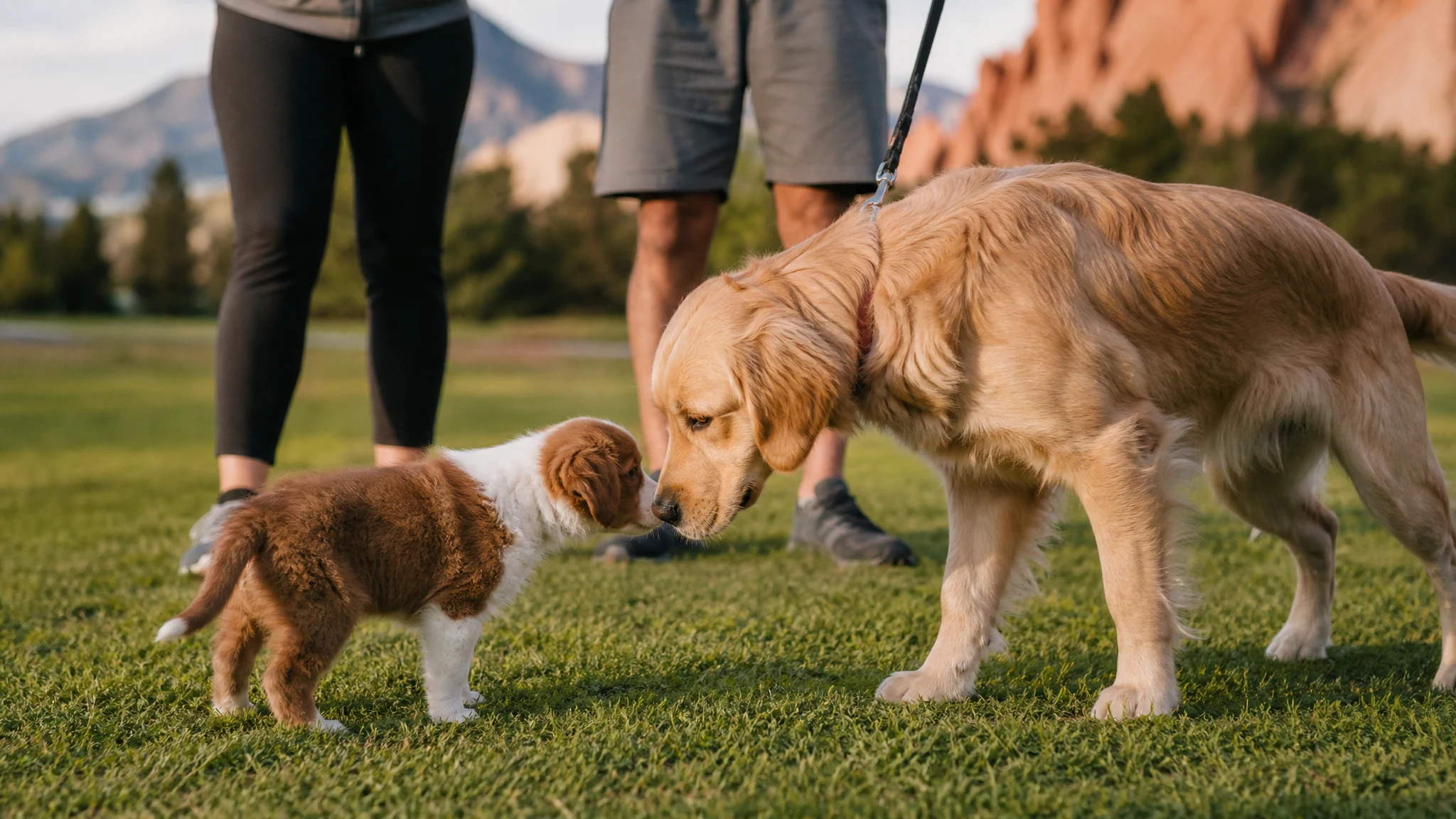
Socialization means helping your puppy have calm, pleasant experiences with the world they will live in. It does not mean forcing meetings. Let your puppy approach at their own pace and reward calm curiosity.
Work through this list over several weeks:
- Sounds: Play recordings of traffic, doorbells and thunder at low volume while your puppy eats or plays. Raise the volume slowly.
- Surfaces: Let your puppy step on tile, carpet, grass, gravel and a wobbly board. Treat each new surface.
- People: Invite calm adults and gentle children to visit one at a time. Ask them to let your puppy come to them.
- Handling: Gently touch paws, ears and mouth, and follow each touch with a treat. This helps later at the vet and the groomer.
- Other dogs: Choose one or two healthy, vaccinated, friendly adult dogs whose owners you know. Keep greetings short.
- Car rides: Start with a short trip to somewhere fun, then home again, so the car is not only for the vet.
Colorado Springs Places and Their Rules
The City of Colorado Springs lists designated dog areas on its dog parks page. Several are fenced, and the city's fenced-park rules for Palmer Park, Cheyenne Meadows Park and Rampart Park include the following:
- Dogs must be accompanied by a person at least 16 years old.
- Dogs stay on leash until inside the enclosure.
- No more than three dogs per person.
- Dogs must be properly inoculated, licensed and not in breeding condition.
- Pinch (prong) and spike collars must be removed before entering.
Because the rules call for proper inoculation, a very young puppy who is still in the vaccine series is not ready for these parks. Ask your veterinarian when that stage arrives. Also, a busy dog park is not a good classroom for shy or small puppies, so think of it as a later step.
The city lists these fenced parks:
- Palmer Park fenced dog park, at the old baseball field about .3 miles from the Maizeland entrance
- Cheyenne Meadows Park dog park, in the south portion off Charmwood Dr. and Canoe Creek Dr.
- Rampart Park dog park, just east of the baseball diamond
- Antlers Dog Park downtown, with separate fenced areas for small dogs and larger dogs, synthetic turf and ADA access
The city also lists unfenced dog runs at Garden of the Gods Park (east of Rock Ledge Ranch and south of Gateway Rd.), the Red Rock Canyon Open Space dog loop, and Yucca Flats in Palmer Park. Hours and fees are not published on the city page, so check with the City of Colorado Springs before you go.
For an early outing, you may prefer a quiet spot to just watch the world from a distance. Sit on a bench near the Antlers Park fence, for example, and feed treats while your puppy watches dogs play without joining in. Confirm with your veterinarian that this suits your puppy's vaccine stage.
Step 5: Build the First Weeks at Home
Class is one hour a week. Most of the learning happens at home, in short, cheerful sessions.
- Set a routine. Puppies do best with regular times for meals, potty trips, naps and play.
- Take them out often. Go outside after waking, eating, playing and every so often in between. Reward right after they finish outside.
- Teach a name and a check-in. Say your puppy's name in a happy voice. When they look at you, reward.
- Teach sit and down with a treat lure. Keep sessions to a few minutes.
- Make the crate a good place. Feed meals there and give chew toys. Never use it as punishment.
- Practice a loose leash. Reward your puppy when they walk beside you. Stop and wait if they pull, then move on when the leash relaxes.
- Practice being alone. Start with a few minutes and build up slowly, which can help prevent barking trouble later.
Rinse and repeat. Several short sessions a day are easier on a puppy than one long one.
Local Hazards to Keep in Mind
Heat. Colorado State University veterinarians warn that heat stroke can be deadly. They advise against dipping a pet in water or using a hose, and suggest giving water and moving the pet to shade or a cool building or vehicle. If you think your puppy is overheated, call your veterinarian right away. Never leave a puppy in a parked car.
Rattlesnakes. A Colorado Parks and Wildlife spokesperson, quoted by KRDO, says prairie rattlesnakes live at elevations up to 9,500 feet but are more common at 7,500 feet and below, and advises keeping dogs on a leash. That report covers the whole state and does not name Colorado Springs, so keep your puppy leashed on trails and call a veterinarian at once after any suspected bite.
Tips for Success
- Keep outings short. Puppies tire quickly, and a tired puppy learns less.
- Reward calm behavior, not just sit and down. Treat your puppy for lying quietly near new things.
- Watch body language. Tucked tail, cowering, yawning, lip licking or hiding mean your puppy needs space.
- Let your puppy retreat. Never push them toward something scary.
- Carry a few treats everywhere in the first weeks.
Common Mistakes to Avoid
- Waiting too long. The early weeks matter. Ask your veterinarian about safe options rather than staying home until every shot is done.
- Flooding. Dropping a puppy into a crowd or a busy dog park can backfire.
- Using punishment. Yelling, scruffing, alpha rolls and corrections can make a puppy fearful. AVSAB advises reward-based training instead.
- Letting rough play go unchecked. If one puppy is hiding or being pinned, step in and take a break.
- Skipping the license. Plan to license your dog once they are over 4 months old.
What Results to Expect
Every puppy learns at a different pace. With steady practice, many puppies begin to respond to their name, sit on cue and settle in a crate within a few weeks. Potty training and loose-leash walking often take longer, and your puppy may seem to forget things during adolescence. That is normal.
Classes may help your puppy become more comfortable around people and other dogs, but no class can promise a particular outcome. Keep practicing, and adjust the pace to your puppy.
When to Get Extra Help
If your puppy shows signs of pain, sudden changes in behavior, or any health problem, see your veterinarian. If a puppy growls, snaps or bites people, talk to your veterinarian and a certified behavior professional soon. In Colorado, the dangerous dog statute (C.R.S. 18-9-204.5) covers dogs that injure people or domestic animals, and HSPPR Animal Law Enforcement takes reports of dangerous or aggressive animals. Early help is kinder to everyone.
Sources
- Humane Society of the Pikes Peak Region, FAQs
- Humane Society of the Pikes Peak Region, License Your Pet
- City of Colorado Springs, Dog Parks
- City of Colorado Springs, Antlers Dog Park
- House of Dog Training, Prices
- House of Dog Training, Trainers
- CCPDT directory, Carol Rebecca Abrams
- CCPDT directory, Miguel A. Gonzalez
- Colorado State University, pet care tips during summer months
- KRDO, Colorado wildlife officials warn rattlesnake season is upon us
- C.R.S. 18-9-204.5, dangerous dogs