Off-Leash Dog Parks in Colorado Springs and How to Train for Them
General training information. For aggression, sudden behavior changes or health concerns, see your veterinarian first.
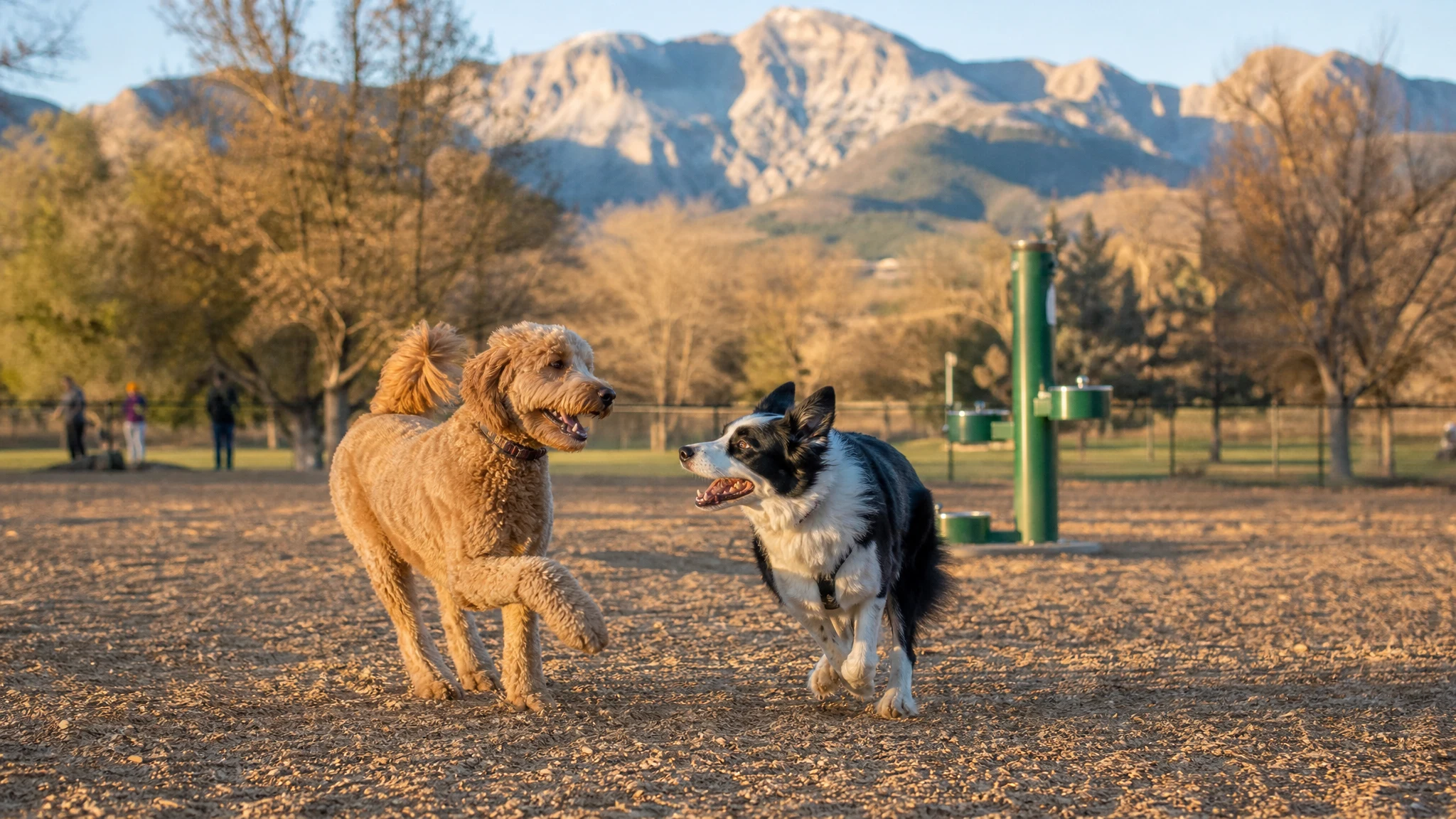
A good day at an off-leash park looks simple: your dog runs, sniffs, plays, and trots back when you call. That ease usually comes from practice done well before you reach the gate.
This guide covers the dog parks in Colorado Springs that the city lists, the rules that apply, and a step-by-step plan to get your dog ready. It also covers the dogs who are better off somewhere else.
Where Off-Leash Dogs Are Allowed in Colorado Springs
The Humane Society of the Pikes Peak Region (HSPPR), which runs Animal Law Enforcement for the area, says dogs must be on a leash at all times except in designated off-leash dog parks. The City of Colorado Springs parks department says the same about city parks and trails: leash required except in designated areas. HSPPR's page does not state a maximum leash length, so check with HSPPR if that matters to you.
If you want an off leash dog park near Colorado Springs, the city's dog parks page lists these. They fall into two types.
Unfenced dog runs
These are open areas where your dog's recall is the only fence. Plan on strong skills before you try them.
- Garden of the Gods Park dog run: the area east of Rock Ledge Ranch and south of Gateway Rd. The city page links a dog map and a policies PDF, so read both before you go.
- Red Rock Canyon Open Space dog loop: designated Dog Loop trail areas south of the main parking lot.
- Palmer Park dog run (Yucca Flats): an unfenced run in Palmer Park.
Fenced dog parks
- Palmer Park fenced dog park: the old baseball field, about .3 miles from the Maizeland entrance.
- Cheyenne Meadows Park dog park: the south portion, a native grass area off Charmwood Dr. and Canoe Creek Dr.
- Rampart Park dog park: just east of the baseball diamond.
- Antlers Dog Park (Downtown Dog Park): in Antlers Park downtown. It has two separate fenced play areas, one for small dogs and one for larger dogs, with synthetic turf. The city says it is ADA accessible.
The city pages do not publish hours for most of these, and no fee is listed for Red Rock Canyon. Check the city parks department before you plan a trip.
The Rules Inside the Fenced Parks
The city lists these enclosure rules for the Palmer Park, Cheyenne Meadows and Rampart fenced parks. For Antlers, its city page does not publish rules, so ask the city what applies there.
- Dogs must be accompanied by a person at least 16 years old.
- Dogs stay on leash until they are inside the enclosure.
- No more than three dogs per person.
- Dogs with an aggressive history must wear a muzzle.
- Dogs must be properly inoculated and licensed, and not in breeding condition.
- Pinch (prong) and spike collars must be removed before entering.
Licensing is a real requirement, not a formality. HSPPR says a license is required for all dogs over 4 months old in the City of Colorado Springs, and that a rabies certificate is needed to get one. HSPPR also says rabies vaccination is required for dogs and cats under Colorado law. HSPPR's licensing page lists fees for 1-year and 3-year licenses, with different rates for spayed or neutered dogs, intact dogs and seniors 65 and older. Check that page for current amounts.
The city's page also does not say which vaccines a dog needs for the parks. Ask your veterinarian what is right for your dog.
Materials You Will Need
- A standard leash and a well-fitted flat collar or harness.
- A long line of about 15 to 30 feet for recall practice in open spaces.
- Small, soft treats your dog loves, plus a few higher-value ones such as cooked chicken or cheese.
- A treat pouch so rewards come quickly.
- Water and a collapsible bowl.
- Your dog's current license and rabies certificate information.
- A quiet practice area, such as a yard, a hallway or an empty field.
Step-by-Step: Training Your Dog for Off-Leash Parks
Use rewards only: treats, toys and praise. This is the humane, reward-based approach that the American Veterinary Society of Animal Behavior (AVSAB) supports. Keep sessions short, about five minutes, and end while your dog is still keen.
Step 1: Build a recall your dog loves
Pick one cue word, such as "Here," and use it only for this. Never call your dog for something unpleasant, like a nail trim or the end of the fun.
- Start indoors, a few feet away. Say the cue once in a happy voice.
- When your dog turns toward you, mark the moment with "Yes!" and reward with several treats.
- Add distance, then a different room, then the backyard.
- Move outside on the long line. Add mild distractions like a person walking by at a distance.
Say the cue once. If you repeat it again and again, your dog learns to ignore the first few.
Step 2: Teach check-ins
A check-in means your dog looks back at you on their own. It is the habit that makes off-leash time feel safe.
- On a walk, wait for your dog to glance at you, then reward right away.
- Do this often on the long line. Your dog learns that checking in pays.
- Slowly reward less often, but keep some rewards surprising and generous.
Dogs who check in often are easier to call before they get into trouble.
Step 3: Practice the gate routine
Most parks use a double-gate entry. The leash comes off only once you are inside the enclosure, so this moment needs calm manners.
- Practice waiting at doors and gates at home. Your dog sits, you open, and your dog waits until released.
- At the park, stop outside the gate. Wait for four paws on the ground and a calm look at you.
- Enter, close the first gate, then unclip the leash inside.
Dogs rushing a gate can overwhelm others already inside. A calm start sets the tone for the visit.
Step 4: Learn to read dog play
You are the dog's advocate. Learn what healthy play looks like and when to step in.
- Good signs: loose, wiggly bodies, bouncy movements, play bows, taking turns chasing, and breaks where both dogs pause.
- Warning signs: stiff bodies, hard staring, tucked tail, hiding behind you, one dog constantly pinned or chased, or growling that does not ease.
If you see warning signs, calmly call your dog away, reward, and give them a break. Do not wait for a fight. If your dog is being rough, call them away for a pause before play resumes.
Step 5: Practice leaving calmly
Leaving is where many dogs fall apart, because the fun ends. Make it easy.
- Call your dog before they are worn out, and reward heavily.
- Clip the leash on, give another treat, then let them go back to play for a minute.
- Repeat several times during a visit, so a recall does not always mean the end.
- When it is time to go, call, leash and leave with a treat in hand.
This "recall, reward, release" pattern helps your dog see your call as good news.
Step 6: Visit in stages
- Watch from outside the fence on the first day, with your dog on leash.
- Go in at a quiet time with few dogs. Stay for about ten minutes, then leave on a good note.
- Build up slowly as your dog stays relaxed and responsive.
- Only try an unfenced run once your recall works well on a long line around real distractions.
Tips and Common Mistakes
- Skipping the long line. Going from a leash straight to open space is a big jump. Use the line until your dog comes back reliably.
- Calling only when it is time to leave. Mix in many calls that end in treats and play.
- Scolding a dog who finally comes. Even if they ran off first, reward the return. Otherwise coming back gets less appealing.
- Using the park to tire out a dog with no skills. A dog who cannot come when called is better served by walks and training games first.
- Staring at your phone. Stay close and watch the body language.
- Bringing a prong collar. The city's enclosure rules require pinch (prong) and spike collars to be removed. Reward-based training does not need them anyway.
- Bringing toys or food to a crowded park. Treats and toys can spark guarding. Keep them in your pouch unless the park is quiet and your dog handles it well.
Colorado Springs Safety Notes
Heat. Colorado State University veterinarians warn that heat stroke can be deadly. They advise against cooling a pet by dipping it in water or using a hose. Instead, give water and move the pet to shade or a cool building or vehicle. If you suspect heat stroke, contact a veterinarian right away. Plan park visits for cooler parts of the day.
Rattlesnakes. A Colorado Parks and Wildlife spokesperson, quoted by KRDO, says prairie rattlesnakes live at elevations up to 9,500 feet but are more common at 7,500 feet and below. The advice was to keep dogs on a leash. That article covers the whole state and does not name Colorado Springs. It is still a good reason to be careful at unfenced runs and open space areas, and to keep your dog close on trails outside the dog loop.
Household limits. HSPPR's Laws and Ordinances page says a household may have up to 4 adult dogs and 4 adult cats under City of Colorado Springs code. An adult is a dog or cat over 4 months old. Inside the fenced parks, the limit is three dogs per person.
When an Off-Leash Dog Park Is Not Right for Your Dog
Dog parks are not for every dog, and choosing not to go is a good decision. Think twice if your dog:
- Is under 4 months old, not fully vaccinated, or not yet licensed. The city's rules require dogs to be inoculated and licensed, and licensing starts at 4 months.
- Is an unspayed or unneutered adult in breeding condition, which the city's enclosure rules do not allow.
- Is fearful, tends to hide, or gets overwhelmed by crowds.
- Guards toys, food or you from other dogs.
- Cannot be called away from a distraction, even on a long line.
- Has a history of aggression toward dogs.
Alternatives work well. Try a long-line walk, a one-on-one playdate with a dog you know, or training games in your yard.
If your dog has bitten or threatened a person, do not use a dog park. Talk to your veterinarian, since pain and illness can drive behavior, and then to a certified behavior professional. Colorado law defines a dangerous dog, according to the Colorado statute C.R.S. 18-9-204.5, as one that inflicts bodily or serious bodily injury on a person or domestic animal, or causes a death. The same statute says an owner whose dog injures a person commits a class 2 misdemeanor. HSPPR Animal Law Enforcement takes reports of dangerous or aggressive animals. Check with them about how it applies to your situation.
Getting Help From a Trainer
A trainer can help with recall, leash skills and reading play. These Colorado Springs professionals are listed with credentials in public directories:
- Carol Rebecca Abrams, CPDT-KA and CBCC-KA, listed in the Certification Council for Professional Dog Trainers directory for Colorado Springs.
- Miguel A. Gonzalez, CPDT-KA, listed in the same directory with HSPPR as employer.
- House of Dog Training lists Pamela Meyerhofer (PDT, PDT-Geek, CPDT-KA) and Astrid Tryon (CPDT-KSA) on its trainers page, along with Angie Neal, listed as CDBC.
This is not a ranking or a recommendation. Ask any trainer about their methods and make sure they use reward-based training. For typical class formats and costs in town, see our guide to dog training classes and costs in Colorado Springs.
What to Expect
Results depend on your dog's age, history and personality, and on how often you practice. Many dogs improve their recall and check-ins with a few weeks of short daily sessions, though some need longer. Dogs who start out shy or reactive may take months, and some may do better with other kinds of exercise.
Progress is not always a straight line. A new park, other dogs or a hot afternoon can set you back, so go back a step when needed. The goal is a dog who is relaxed, responsive and safe, wherever that is.
Sources
- City of Colorado Springs Parks: Dog Parks
- City of Colorado Springs: Antlers Dog Park
- Humane Society of the Pikes Peak Region: FAQs
- Humane Society of the Pikes Peak Region: License Your Pet
- Humane Society of the Pikes Peak Region: Laws & Ordinances
- C.R.S. 18-9-204.5, dangerous dogs
- Colorado State University: pet care tips for summer
- KRDO: Colorado wildlife officials warn rattlesnake season is upon us
- CCPDT directory: Carol Rebecca Abrams
- CCPDT directory: Miguel A. Gonzalez
- House of Dog Training: Trainers